
Wildfire2026
Programme
Programme is not final and is subject to change

New Perspectives, Shared Solutions
Wildfire is no longer a distant, rare or exceptional risk for the UK. It is becoming an increasingly common and disruptive feature of our changing climate, with consequences for landscapes, communities, ecosystems, infrastructure and emergency services. In 2025, the UK experienced its worst year for wildfire on record, and the Dava Moor wildfire in Scotland has since been described by researchers as the UK’s first recorded “megafire”.
The warning signs have continued into 2026, with several wildfires across the UK placing renewed pressure on fire and rescue services, land managers, communities and emergency planners. During the July heatwave, emergency services were reported to be dealing with multiple severe wildfires across Britain, with major incidents declared in parts of Wales and Derbyshire.
Against this backdrop, the theme of Wildfire2026, “New Perspectives, Shared Solutions”, could not be more timely. Fire and rescue services, land managers, researchers, policymakers, insurers, emergency planners, conservation bodies, communities and international partners each hold a vital piece of the puzzle. The question is no longer simply whether wildfires will happen, but how prepared we are to anticipate, prevent, respond to and recover from them together.
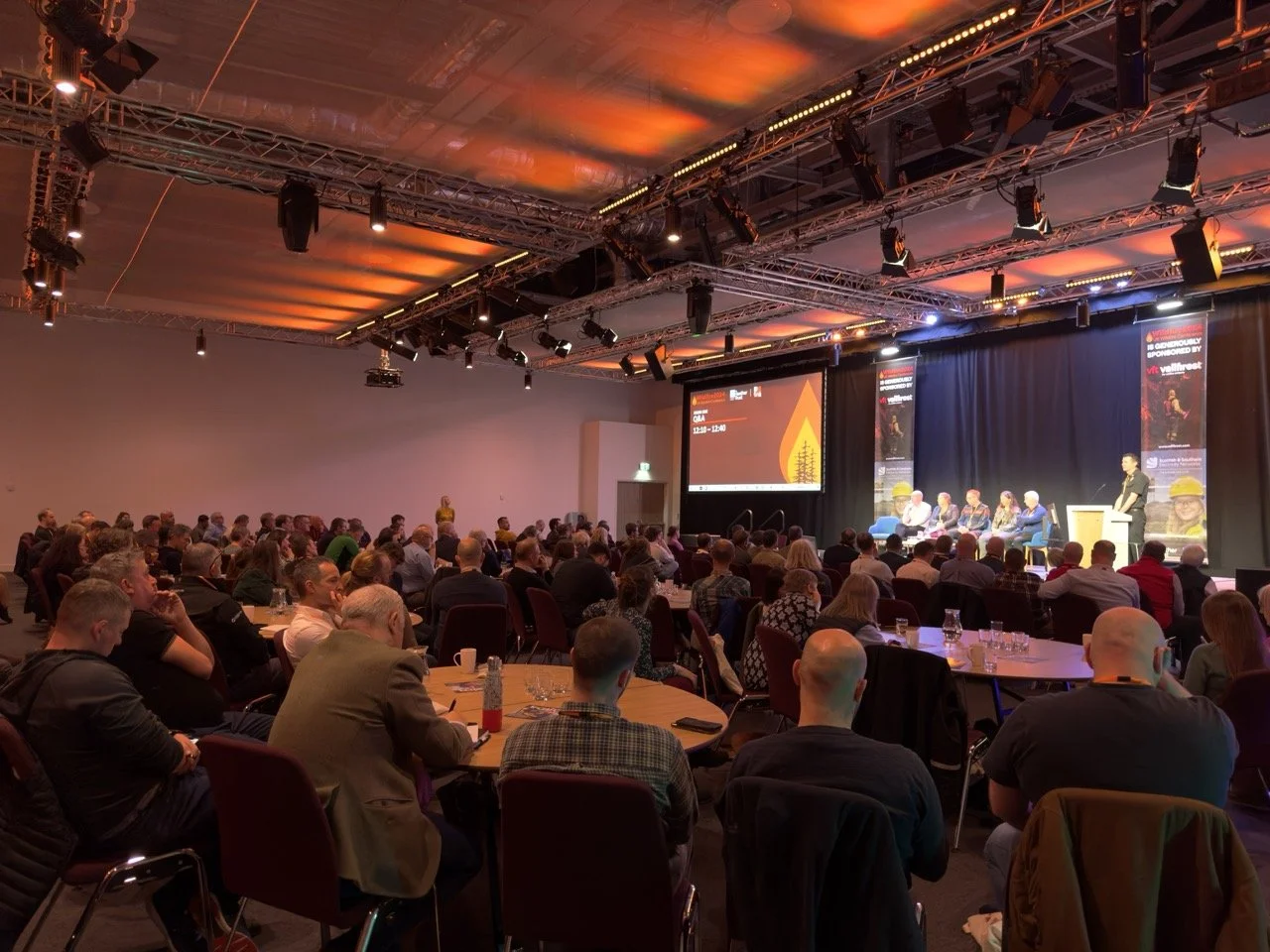
Across two days, Wildfire2026 brings these perspectives together. Through keynote addresses, expert sessions, panel discussions, posters and interactive workshops, the programme will explore wildfire governance, habitat management, community preparedness, the wildland urban interface, infrastructure risk, fire behaviour modelling, decision-support tools and lessons from major incidents in the UK and overseas.
At its heart, Wildfire2026 is about shared responsibility. Preparing for wildfire cannot rest with one organisation, profession or community alone. It demands new thinking, stronger partnerships and practical solutions shaped by many voices.
Marsden Moor Site Visit
9th November 2026
This visit takes us to the iconic Marsden Moor area of the South Pennines, owned by the National Trust. We will look at landscape and peatland restoration work on a site that is heavily visited and has suffered from a series of fires over recent years. Delegates will see firsthand how the National Trust and Moors for the Future are working with others; using rewetting techniques as part of a suite of approaches aimed at making the site more resilient to fire and other climate pressures whilst continuing to support biodiversity and farm businesses.
The day will be in two halves, with an interactive workshop and a guided walk across the moorland site with lunch and a discussion in the middle.
Wildfire2026 Day 1
10th November 2026
Programme is not final and is subject to change
8:45 – Registration
9:30 – Opening addresses
10:00 – KEYNOTE
Matthew Jones, University of East Anglia
“State of Wildfires Report and the Drivers of Extreme Fire Events”
10:30 – WILDFIRE GOVERNANCE
Sophy Greenhalgh, Leverhulme Centre for Wildfires
“Wildfire as a National Resilience Challenge in the UK: Governance Gaps, Emerging Capacities and Pathways Forward”
Maria Barbosa, UK Centre for Ecology and Hydrology
“Climate evidence for Loss & Damage in the context of Wildfires in Amazonia and Pantanal Biomes”
11:05 – Coffee
11:30 – WILDFIRE GOVERNANCE
Christine Erikson, Swiss Federal Institute of Technology / ETH Zürich
“A Whole-of-Community Approach: New Perspectives from the Swiss Alps – Shared Solutions for the UK”
Rob Gazzard, Forestry Commission
“From Risk to Readiness: Practical tools for integrated wildfire planning within a UK context”
Bibiana Alejandra Bilbao, Universidad Simón Bolívar / COBRA Collective
“Shared Fire, Shared Challenges: Intercultural Lessons from Europe and Latin America for Integrated Fire Management”
Haley Ritchie, York University
“The many designs and institutionalizations of predictive service supports”
Further talks to be announced
12:30 – Lunch
13:30 – KEYNOTE
Evrim Bunn, Senior Advisor / U.S Wildland Fire Service
“How Community-level Wildfire Preparedness Can Shape National and International Action”
14:00 – CHALLENGES ASSESSING WILDFIRE IN THE WILDLAND URBAN INTERFACE
Patrick Ball, Inigo Insurance
“Wildfire Exposure Management in Insurance through Physically Grounded Tail-Risk Scenarios”
Richard Flemming, Map Impact
“The Financial Regulation Perspective to Elevating Wildfire Risk”
Ruth Vanhaecht, Ghent University
“Modelling Wildfire Spread in Traditionally Non-Fire-Prone Regions - The Case of the Benelux”
Joe Hart, Delta Research and Development Ltd
“Analysing the 2025 Palisades Fire: Field Evidence and Post-Fire Insights from Los Angeles”
15:05 – Coffee
15:30 – KEYNOTE
Elsa Pastor, Technical University of Catalonia – BarcelonaTech
“Industrial Infrastructure Under Wildfire Threat and the Challenge of Resilience”
16:00 – INFRASTRUCTURE PANEL
Planning for Critical Infrastructure Wildfire Resilience
As climate change brings hotter drier summers, our critical infrastructure is becoming increasingly exposed to wildfires. Awareness of the changing risk and proactive planning are essential to limit damage and disruption. This industry-focused panel session explores strategies to design, operate, and invest in infrastructure that can withstand and rapidly recover from wildfires. Topics include climate risk and vulnerability assessments, infrastructure adaptation, and the use of advanced modelling and analysis techniques to inform investment decisions. This panel brings together leading technical experts on climate adaptation and planning from across the power, rail, water and insurance sectors providing valuable insight for practitioners, policymakers and the wider research community.
Panelist, Role, Company, Sector
Elsa Pastor, Professor, Technical University of Catalonia, Research
Katy Ivison, Climate Change Specialist, Severn Trent, Water
Gareth Pearson, Director of Health, Safety and Training, Northern Power Grid, Power
Michael Norbury, Climate Change Adaptation Specialist—NW and Central Region, Network Rail, Transport
Daniel Bannister, Weather and Climate Risks Research Lead, Willis Towers Watson, Reinsurance
17:00 – CLOSE
17:15 - 18:15 – POSTER SESSION
The posters featured at Wildfire2026 and displayed throughout the conference highlight significant contributions from professionals, researchers, and emerging experts in wildfire science and environmental studies. We encourage you to take this opportunity to engage with the presenters during this poster session, as well as during coffee breaks and lunch periods, to discuss their research in depth, exchange ideas, and learn more about their findings.
19:00 – DRINKS RECEPTION
19:30 – GALA DINNER
Please note that the programme is not yet final and may be amended without notice.
Wildfire2026 Day 2
11th November 2026
Programme is not final and is subject to change
8:30 – Registration
8:45 – Opening addresses
9:15 – KEYNOTE
Nick Allenby, North Yorkshire Fire and Rescue Services
“Lessons from Fylingdales Moor: The Largest Wildfire in North York Moors History”
9:45 – MANAGING UK HABITATS
Nick Kettridge, University of Birmingham
“IDEAL UK FIRE: Ecological and Carbon Impacts of Fuel Management Practices used in Temperate Heathlands in the UK”
Robert Hughes, Royal Society for the Protection of Birds (RSPB)
“Wildfire resistance and resilience as emergent properties of ecosystem following ecological restoration”
Andreas Heinemeyer, University of York
“Rewetting & Wildfire: considering complexities vs claims for UK upland peatlands”
Further talks to be announced
10:50 – Coffee
including a two-minute pause for reflection during the 11 AM Remembrance Day commemorations
11:15 – INTERACTIVE WORKSHOPS
Delegates are encouraged to choose and participate on a workshop, then work with others from different backgrounds and perspectives to find shared solutions.
Room 1: Shared responsibility in the wildland urban interface
Room 2: Planning for fire — How would you design a moorland landscape?
Learn more about the workshops
12:15 – Lunch
13:15 – KEYNOTE
William Matthew Jolly, US Forest Service, Rocky Mountain Research Station, Missoula Fire Sciences Laboratory
“Understanding Live Fuels to Transform Fire Danger Modelling and Decision Support Systems”
13:45 – WILDFIRE RISK AND EXTREMES
Sidra Khan, Wildfire Analytics, University of Alberta
“Shared Solutions for Wildfire Risk: Linking Exposure Mapping with Community Preparedness”
Zak Derler, University of Birmingham
“Rethinking Wildfire Anomalies: A New Framework for Detecting Anomalous Fire Intensity and Regime Volatility”
Anthony Trojko, WATERAX
“Smoke jumping”
Further talks to be announced
14:45 – Coffee
15:15 – WILDFIRE TOOLS AND SERVICES
Stefan Doerr, Swansea University
“FireInSite: an accessible tool for predicting ignition probability and fire behaviour in the UK and Atlantic Europe”
John Clarke, National Gamekeepers’ Organisation
“Wildfire Risk Index”
Rebecca Bronlow & Joe Glentworth, Sheffield Hallam University & University of Manchester
“Detecting and measuring the impacts of upland vegetation fires on air quality”
16:00 – CLOSING REMARKS
16:15 – CLOSE
Please note that the programme is not yet final and may be amended without notice.
Research Posters
A spotlight on wildfire research
The posters featured at Wildfire2026 and displayed throughout the conference highlight significant contributions from professionals, researchers, and emerging experts in wildfire science and environmental studies.
Can management through cutting assist in maintaining soil moisture and increase wildfire resilience in heathlands?
Sarah J. Baker Stefan Doerr (Swansea University);
Claire M. Belcher (University of Exeter);
Kerryn Little, Nicholas Kettridge (The University of Birmingham)
Fuel Management Changed Peat Loss and Carbon Emissions from the Langdale Moor Wildfire
Claire Belcher (University of Exeter);
Sarah Baker (Swansea University)
Vegetation growth after a wildfire
Katie Estorque
Leeds Beckett University
A new approach for mapping the severity of organic soil carbon loss in peatlands
Romy C. Franz Bodenham, Claire M. Belcher (University of Exeter);
Sarah J. Baker, Stefan H. Doerr (Swansea University);
Kerryn Little, Nicholas Kettridge (The University of Birmingham)
Modelling the impact fire exposure has on electrical infrastructure systems
Reuben Bunting, Daniel Donaldson, Kerryn little, Nick Kettridge
University of Birmingham
Semi-automatic wildfire registration and data improvement for Belgium
Fara Coppens, Jan Baetens, Frieke Vancoillie
Ghent University
Community involvement in wildfire risk reduction through a social contract lens: a case study in Yellowknife, Northwest Territories, Canada
Fanhui Dong
University of Leeds
X-band SAR Burnt-Area Detection: Operational Lessons from a Constellation Archive
R. Peter Dorn, Eric Walmsley, Aymeric Mainvis
ICEYE
A predictive risk framework for expected losses from extreme wildfire events in the Western Cape, South Africa
Harry Gilson, Willem Stefaan Conradie, Phindile Sabela-Rikhotso
University of Cape Town
From Detection to Forecasting: An End-to-End Wildfire Intelligence Platform for Near Real-Time Decision-Making
Savvas Gkantonas, Michael Young, Ignasi Alemany, Connor Smith, Ethan Yi-Tun Lin, Daniel Fredrich (Pinepeak Ltd);
Andrea Giusti (Imperial College London);
Epaminondas Mastorakos (University of Cambridge)
Field-Based Mapping and Characterisation of Urban and Peri-Urban Vegetation for Wildfire Mitigation in Los Angeles
Joe Hart, Katherine Burgum
Delta Wildfire Research Group, Delta Research and Development
Assessing wildfire risk to water services
Katy Ivison, Tom White
Severn Trent
Prolonged drought exceeds extreme heatwave as driver of record low fuel moisture content in a temperate heathland
Kerryn Little
University of Birmingham
UK Upland Peatlands: How Heather Management Influences Rewetting and Wildfire Resilience
Bing Liu
University of York; Stockholm Environment Institute
Responding to the Interface - Increasing Fire Fighter safety through decision frameworks and tactical engagement
Blake Miller, Joe Ten Eyck
International Association of Fire Fighters
A Habitat Driven Approach to Wildfire Prediction and Forecasting
Nina Moiseeva
Map Impact
The influence of traditional UK moorland vegetation management mosaics on fire spread
Zahra Mousavi, Claire Belcher, Sarah Baker
University of Exeter
Mapping Moorland Flame Length Potential Using New Approaches to Remotely Identify Fuels
Ben Phillipson, Claire M. Belcher (University of Exeter);
Aland H. Y. Chan, David A. Coombes (University of Cambridge)
Prescribed burning increases wildfire severity in UK upland moorland
Mike Shewring
Royal Society for the Protection of Birds (RSPB)
Smoke-stimulated Germination in UK Heathland Plants
Green Smith, Claire Belcher, Sarah Baker (University of Exeter wildFIRE Lab);
Christopher De Wolf (University of Exeter Mass Spectrometry Facility);
Gabriel Yvon-Durocher (Exeter University Environment and Sustainability Institute)
Wildfire Recovery Project in Northern Ireland
Mark Smyth, Guillem Canaleta, Víctor Riera, Núria Prat-Guitart (Pau Costa Foundation);
Matthew Bushby (independent consultant);
David Wilson (Earthy Matters);
Claire Belcher (University of Exeter);
Thomas Smith (London School of Economics and Political Science);
Gareth Clay (University of Manchester)
Meteorological and Spatial Drivers of Flammability for Major UK Vegetation Types – a Case Study in the Bannau Brycheiniog National Park
Megan Thomas
Swansea University
The Law according to Wildfires
Damian Threader
Peak District National Park Authority
How an innovative data collection and recording system can be used to inform management strategies for increasing wildfire resilience on complex habitats like blanket bogs
Paul Titterton, Steve Maynard, Ted Talbot, Jody Vallance
Moors for the Future Partnership
Drivers of invertebrate abundance and occupancy in UK moorlands: a mechanistic approach
Joseph P. Wayman, Nick Kettridge, Tara Jeffery, Laura J. Graham (University of Birmingham);
Kevin J. Gaston (University of Exeter)
The first names listed are the presenting authors for each respective poster.